Pages

Showing posts with label inspiration. Show all posts

Monday, October 29, 2012

From The Land Fesitval


On Sunday morning we headed up toward Green Lake, Wisconsin to check out the 10th Annual From The Land Festival. We loved the laid back feel and the small simple farm as the backdrop. We could smell the pasture of sheep as we browsed through the vendors. We managed to come home with some Wisconsin grown roving, new angora spinning knowledge, and a delicious grass-fed rump roast. We were definitely among friends - people who live or aspire to live as we want to, to embrace handmade, the hand crafted, the homegrown and the simple things. There is a complete satisfaction when buying something and you are actually meeting the maker or producer. You see the character and craftsmanship and we are always willing to pay more for something that is handmade or homegrown because you see the quality, you see the care and time that has gone into the item.

Think about this, especially with the holidays approaching. We will soon be swarmed by commercials and ads telling us what to buy (almost all of it is mass produced). Try buying locally from an art fair, on Etsy or even make some gifts yourself. We are making about 75% of our gifts this year and we are so looking forward to give the gift of handmade.

Have a great week everyone! Thanks again for taking time to read our blog. We appreciate our readership and support very much!


Wednesday, April 11, 2012

I Want To Be A GREENHORN


I love this community of young farmers I discovered through Cold Antler Farm. I see what people my age are doing and I beam with excitement. These farmers are at the forefront of the food revolution and will ensure the prosperity of our future food supply and the health of our nation. Also check out the book that will be released May 8th.
 

Saturday, February 25, 2012

Folks, this ain't normal

The food production system that we have all been accustomed to is a product of wanting cheap and efficient processes to get any food that we crave onto our tables. If we want a strawberry in winter, we go to the store and buy it. According to Joel Salatin this ability to buy out of season is relatively new and frankly, is not normal. His book, "Folks, this ain't normal" he challenges modern agriculture way of thinking, showing how it hurts the earth and animals farmers are supposed to be stewards of, as well as the people that farmers are meant to feed and keep healthy. He also presents how local farmers that think of animals (including humans) and the land as having a symbiotic relationship can actually have higher yields of product that are more nutritious that what we are accustomed to seeing in the supermarket and actually builds the soil in the process.

Salatin go to great lengths to beat into people that how we eat food today is not in any way historically normal. People do not store food anymore. Canning, freezing and dehydrating were the ways people were able to "eat in season." There were no supermarkets until the 1940's. Before then, everybody grew their own food. Now people buy from the store and have no idea as to how that food got there or the consequences of getting that food into the supermarket. People will also not think twice about throwing out food scraps that could otherwise be used as feed to chickens (yes, chickens are omnivores) and pigs that can be turned into meat for the table, or the scraps can be composted and, in turn, be used to grow produce. Either way, in my opinion, is much more superior than sending them to a landfill.

Salatin also shares that regulations meant to keep food safe for consumption is more meant to keep the existing mega producers in business and prevent competition from local farmers and indirectly creates lower quality food. I never knew that commercial eggs are put into a chlorine bath before shipping (eggs are porous!) before reading this book. Also, according to regulations a meat handler cannot be a poultry handler. Those are two different professions and the two cannot intermix. He shares a story of how it is easier for Tyson to get their chickens into a restaurant than it is for a local farmer located two miles from that same restaurant. He also shares that even if a restaurant or college wants to have a local food initiative, no compete clauses with their existing food vendors prevent it from happening.

There is a point here that I would like to get on my soapbox about and I am echoing what is found in this book. People no longer want to take responsibility for their actions. People except somebody else to find them and label them "Approved." If everyone where to start asking questions about their food and taking ownership of what goes into your body, I believe that obesity and drug resistant diseases would no longer be issues. If I want buy some food, it should be my responsibility to find the best sources and, more importantly, not choose from sources I do not like for one reason or another. I am perfectly capable of finding good food without the USDA thank you very much.

So go out there, local farmers are waiting for your business. Join a CSA, you are not only getting higher quality food, but you are indirectly being a better steward of the Earth. And if you want to get "crazy," grow some of your own. I know it opened my eyes to how food does not just magically show up in the aisle at the grocery store. For starters, read this book!


Friday, February 10, 2012

Back to Eden


One of the lasting observations from last year's garden was the fact that as the summer months wore on, the ground became so hard and compact that I could barely scratch the surface. Weeding was near impossible and I could not imagine how that was affecting the growth and production of the vegetables. The soil was also light brown and not the dark brown and black that I knew described healthy soil. I began thinking that there must be a better way to garden and not have the soil pay dearly.

Thanks to Jack Spirko at the Survival Podcast, who in turn pointed me to Paul Wheaton at permies.com, I was turned on to permaculture. Using the natural processes found in forests and bringing them into the garden is an extraordinary idea and frankly was one of those "duh" moments for me. One of the core ideas behind permaculture is to keep the rain that falls on an area for as long as possible.

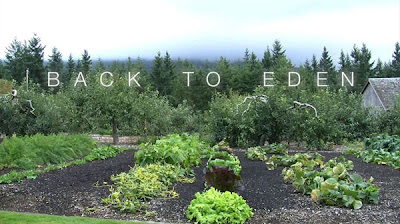
At permies.com, this movie, "Back to Eden" is found all over the forums and I just had to check it out. The movie showcases Paul Gautschi in Washington state and his wonderfully simple idea of using wood chips to do all of the work for him the garden. The wood chips continually nourish and hydrate the soil to create near ideal conditions to grow. The same process can be found in any forest as the dead trees, dead branches and leaves continually lay down a layer of mulch which turns the soil into a huge sponge. This simple idea makes land that is both drought proof and flood proof.

Something like this is so simple that I have got to try it out for this year's garden. Hopefully this will be the cure for the peas wilting in the first heat of summer and keep the blight off of my tomatoes. I do not have to rely on this food yet, so I still have time to experiment. As Joel Salatin says, "If it's worth doing, it's worth doing wrong." You can't be afraid to try something different. Frankly, I don't see a downside to trying this.

Tuesday, October 25, 2011

Uke Me


I often feel I need to conquer as much as I can in this life. I will try something even if I end up being terrible at it, at least I can say I got the experience. My talents fall more toward the arts than music, but I'm told I got a decent singing voice and used to sing in a band and I used to play flute in grade school. But I always wanted to play something that could accompany my voice and I could take out around a campfire.

I tried guitar for a while but it never really captured me. I have often picked up the ukulele at the local music store and liked the size, the fact that it only had four strings and that it was very portable. It is also hunting season (as you may know from Jake's previous post) and I have been spending many nights alone (with a freezer full of deer and pheasant meat - but I am NOT complaining) and I can only knit and sew so much until my hands feel like they are going to fall off, so a new project is in order.

So...I bought a ukulele.

I found a really nice Kala that sounds fantastic and at $50 on Amazon, I figured it was a good price and fit into my budget. I was going to buy something cheaper but after looking at some of the ukes in the $20 to $30 range, the reviews from beginning players were not so good. I wanted a uke that would encourage me to learn, not a uke that would give me a lot of frustrations and end up collecting dust, so I opted for the more expensive one. I guess you get what you pay for.

Also, after doing some research, I came across Ukulele Underground. an online community of a new breed of uke players. This site will be my uke bible with all the video tutorials, forums and groups (I will be joining the Midwest group).

So wish me luck with yet another hobby, but music is always a great asset to life! Does anyone else play an instrument? Or have you always wanted to learn to play and instument, what is it?

Monday, September 5, 2011

Media with a message


We were deeply moved by this commmercial. Not only does Willie Nelson do a cover of Coldplay's The Scientist, but the animation portrays an important message that we believe in, and if a food chain can source locally, than it is posssible we all can.

Monday, August 22, 2011

Jenna, this is all your fault


The Simplestead couple are big fans of Jenna Woginrich of Cold Antler Farm, so much that we can wholeheartedly list her as number one on our culprits list of why we are in our current state of mind. Jenna truly inspires us to be homesteaders. Who knew a Graphic Designer could know so much about beekeeping, chicken raising, gardening and even horse carting?

Jenna's first book, Made from Scratch outlines her trials and tribulations of starting her own homestead. Once you read the book, you'll crave more. Lucky for us, Jenna has her blog that documents her ever evolving homestead, complete with a herding dog in-training, rabbits, sheep and a never ending supply of good stories. The book and blog have single-handily catapulted us into hoe-loving localvores who are now armed with a community garden, a compost bin and a plan to one day own our own homestead. If anyone asks, just blame Jenna.

Be sure to check out the Cold Antler Farm blog and watch for Jenna's new book Barnheart in December 2011 (yeah, we already got a signed pre-ordered copy reserved for ourselves).